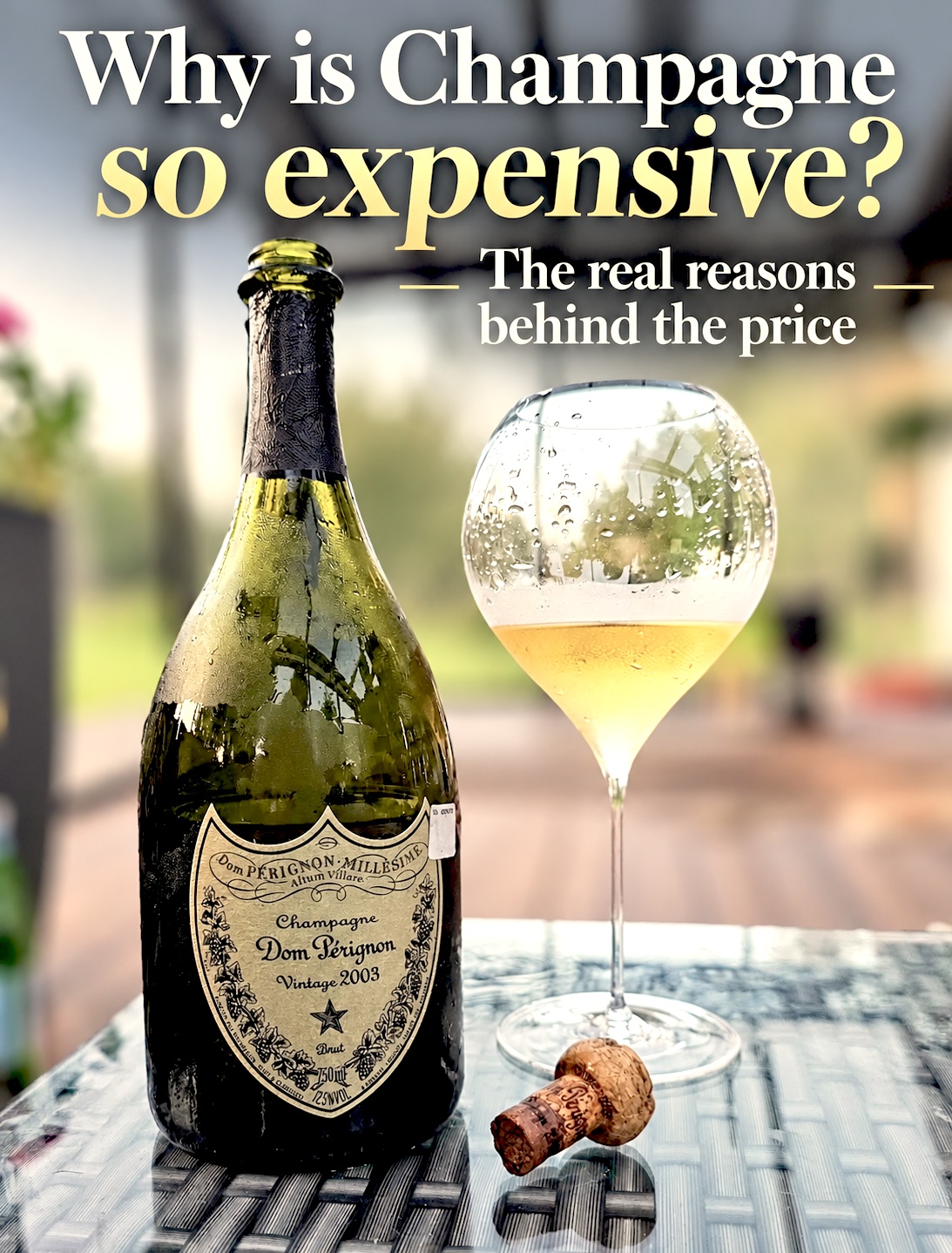
You pick up a bottle of Champagne and notice the price tag is five, ten, sometimes twenty times more than a perfectly good sparkling wine from Spain or Italy. What is going on? Is it just marketing, or is there something real behind those numbers? The answer, it turns out, is both – and understanding why makes you a much smarter buyer.
The land costs a fortune
Champagne can only be made from grapes grown in a strictly defined region of northern France. That region is small, demand is enormous, and the best vineyard plots – the grand cru villages around Reims and Épernay – rank among the most expensive agricultural land anywhere on earth. A single hectare in a top grand cru village can sell for over a million euros. Before a producer makes a single bottle, the cost of ownership or the price paid for those grapes is already extraordinary. That cost flows directly into what you pay at the shelf.
Every grape is picked by hand
Champagne regulations require the harvest to be done entirely by hand – no mechanical pickers allowed. The Champagne harvest employs tens of thousands of seasonal workers for just a few weeks each autumn. It’s a logistical and financial operation on a scale that most wine regions never attempt. Add to that the strict limit on how much juice can be pressed from each kilogram of grapes, and you can see how the raw material alone sets Champagne apart from cheaper sparkling wines before any production even begins.
Time is the most expensive ingredient
Champagne gets its bubbles from a second fermentation in the bottle – a process called méthode traditionnelle. After that fermentation, the wine must age in the bottle on its spent yeast, a process called sur lattes. The rules set minimum aging times, but serious producers go well beyond them. A non-vintage Champagne from a quality house might rest for three or four years before release. A vintage Champagne could spend six to ten years in the cellar. A prestige cuvée like Dom Pérignon is held back even longer. All that time ties up capital, space, and inventory that the producer cannot sell. The interest on those invisible costs is part of what you are paying for.
Prestige cuvées are a different category
The most expensive Champagnes – the ones that show up on restaurant wine lists with eye-watering price tags – are what the industry calls prestige cuvées. Think Dom Pérignon from Moët & Chandon, Krug Grande Cuvée, Cristal from Louis Roederer, or Belle Époque from Perrier-Jouët. These bottles represent each house’s absolute best: the finest grapes from the finest plots, assembled by the most experienced winemakers, and aged far longer than anything in the regular range. Production is limited. Demand from collectors, restaurants, and gift-givers is high. That equation almost always leads to a higher price.
It’s also worth knowing that prestige cuvées vary enormously in what they actually deliver. Some genuinely represent winemaking at its peak. Others are, in part, paying for a famous bottle and the prestige of the name on the label. The good news is that at Champagne Hunters we love helping people discover which bottles offer real quality, not just a recognisable face.
The house name carries real weight
The big Champagne houses have spent decades – sometimes centuries – building consistency. When you buy a bottle of Krug or a bottle of Pol Roger, you’re paying partly for the guarantee of a certain experience. Maintaining that consistency across hundreds of thousands of bottles, year after year, regardless of what the harvest threw at the winemaker, requires enormous investment in expertise, equipment, and reserve wines. Small grower-producers can deliver exceptional quality and outstanding value, but the brand reliability of the grandes maisons has its own very real cost.
So is expensive Champagne worth it?
Sometimes yes, sometimes no – and knowing the difference is exactly the kind of thing we’re here for. A well-chosen bottle at a mid-range price from a quality house or a talented grower-producer can be every bit as thrilling as a prestige cuvée at three times the price. But when a special occasion calls for something truly memorable, a bottle that has been cared for across a decade in a cold Champagne cellar can deliver an experience that justifies every penny. The key is knowing what you’re paying for.
If your curiosity is leaning towards real Champagne, you’re in the right place. Explore our map to find spots near you that pour genuine Champagne by the glass or bottle, and join a community of fellow enthusiasts chasing the same sparkle around the world.