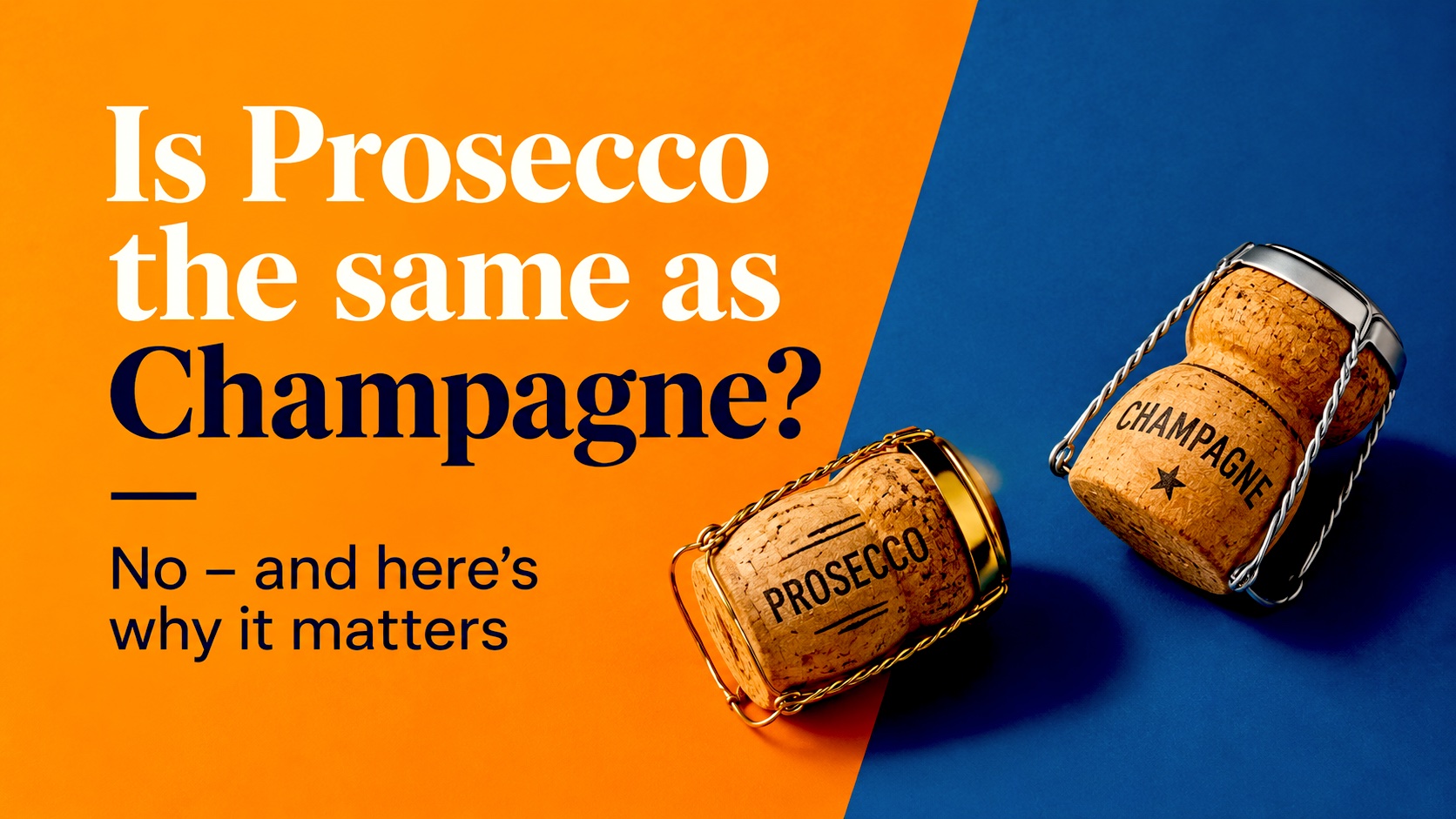
Prosecco and Champagne are both sparkling, both come in a fancy bottle, and both make an appearance at celebrations. So people often use the names interchangeably. But they are not the same thing – not even close – and once you understand the difference, you’ll never mix them up again.
The short answer
No, Prosecco is not Champagne. Champagne is a protected name that can only be used for sparkling wine made in the Champagne region of north-eastern France, following strict rules on which grapes can be used and how the wine must be produced. Prosecco comes from north-eastern Italy – mainly the Veneto region – and is made in an entirely different way. Calling a Prosecco a Champagne is a bit like calling a Parma ham a prosciutto di Champagne. Geography matters, and in the wine world it matters enormously.
Where they come from
Champagne comes from a specific, legally defined zone around the cities of Reims and Épernay in France. The three main grapes are Chardonnay, Pinot Noir, and Pinot Meunier. The cool northern climate and chalky soils give Champagne its characteristic freshness and mineral edge.
Prosecco comes from the hills of Veneto and Friuli Venezia Giulia in north-eastern Italy. The main grape is Glera. Prosecco DOC is the broad category you find everywhere; Conegliano Valdobbiadene DOCG is the more prestigious subzone, with the single-vineyard Cartizze at the very top.
How the bubbles are made – the big difference
This is where Champagne and Prosecco truly part ways.
Champagne uses the méthode traditionnelle: a second fermentation happens inside each individual bottle. The wine then ages on the spent yeast (called lees) for months or years, which is where Champagne gets its signature brioche, biscuit, and toasty complexity. The process is slow, labour-intensive, and expensive.
Prosecco is almost always made using the Charmat method (also called the tank method): the second fermentation happens in a large pressurised tank, and the wine is then filtered and bottled under pressure. It’s faster, cheaper, and produces a lighter, fruitier, more straightforwardly fresh style. Neither method is “wrong” – they simply produce very different wines.
How they taste
Champagne tends to show more complexity: think green apple, lemon zest, brioche, toasted nuts, and sometimes a chalky mineral note. The bubbles are typically fine and persistent. With age, great Champagne develops into something extraordinary – honeyed, nutty, almost savoury.
Prosecco is usually lighter and more immediately approachable: white peach, pear, cream, and fresh flowers. The bubbles tend to be a little larger and softer. It’s designed to be drunk young and enjoyed without overthinking. That’s genuinely a virtue in the right context.
Does price tell the whole story?
Prosecco is almost always less expensive than Champagne – sometimes dramatically so. That’s largely a function of the production method (tank fermentation is far quicker and cheaper than bottle fermentation) and the cost of land and grapes in each region. A good entry-level Champagne will cost you two to four times what a decent Prosecco does.
But that doesn’t mean Champagne is always “better” – it means it’s different. Prosecco is a wonderful aperitivo wine. A spritz on a summer evening, a light brunch drink, a casual toast – Prosecco excels in all of those moments. When you want depth, complexity, and something genuinely special in the glass, that’s when real Champagne earns its price.
Which one should you choose?
Know what you’re looking for. For a casual get-together, a weeknight treat, or a mimosa brunch, a good Prosecco is a completely sensible choice. For a birthday dinner, an anniversary, or any moment where the drink itself is part of the celebration, reach for a real Champagne. The two wines aren’t rivals – they just have different jobs, and now you know exactly which one to call on.
If your curiosity is leaning towards real Champagne, you’re in the right place. Explore our map to find spots near you that pour genuine Champagne by the glass or bottle, and join a community of fellow enthusiasts chasing the same sparkle around the world.