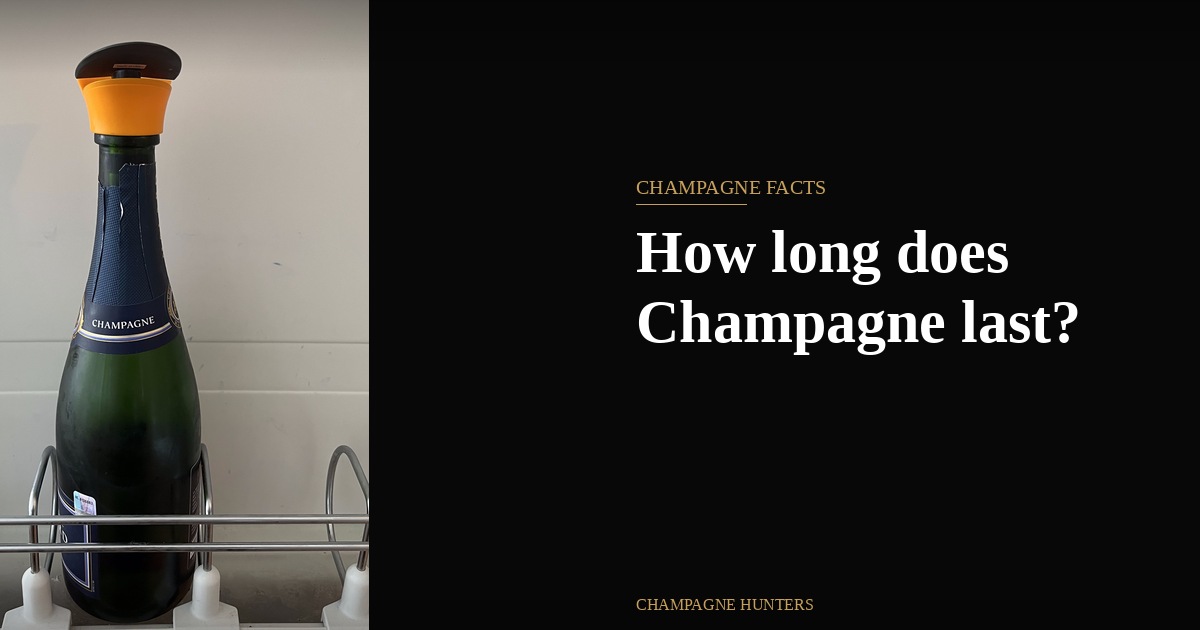
Champagne doesn’t last forever, but how long it stays at its best depends on whether the bottle is unopened or already opened. Most non-vintage Champagne is best enjoyed within 3 to 5 years of purchase, while vintage Champagne can continue developing for 5 to 10 years or even longer when stored properly. Once opened, Champagne is usually at its best for 1 to 3 days if sealed with a Champagne stopper and kept refrigerated.
The good news is that Champagne is made for moments worth remembering, whether that’s a birthday, a quiet Friday evening, or simply celebrating making it through another week. Knowing how long a bottle lasts means you’ll enjoy every bubble exactly as the winemaker intended.
Table of contents
- How long does unopened Champagne last?
- How long does opened Champagne last?
- How should Champagne be stored?
- Does vintage Champagne last longer?
- Can Champagne go bad?
- Signs your Champagne is past its best
- Champagne Hunters tip
- FAQ
- Conclusion
How long does unopened Champagne last?
One of the most common questions is simply, how long does unopened Champagne last?
The answer depends on the style of Champagne and how it has been stored.
A non-vintage Brut, which makes up most bottles from major Champagne houses, is blended to deliver a consistent style every year. Although it’s ready to drink when released, it generally stays at its best for around 3 to 5 years after purchase if stored in a cool, dark place.
Vintage Champagne is different. Made only in exceptional harvest years, it usually has greater structure and acidity, allowing it to age beautifully. Many vintage Champagnes continue improving for 5 to 10 years, while prestige cuvées from great producers can evolve for decades.
Unlike ordinary sparkling wine, Champagne’s fine bubbles and high acidity help protect the wine as it matures.
How long does opened Champagne last?
If you’ve already heard the satisfying pop of the cork, the clock starts ticking.
An opened bottle of Champagne typically stays fresh for:
| Storage method | Approximate freshness |
|---|---|
| Left open at room temperature | A few hours |
| Refrigerated without stopper | About 1 day |
| Refrigerated with a Champagne stopper | 1 to 3 days |
The biggest challenge isn’t spoilage. It’s losing carbonation.
Those tiny bubbles carry much of Champagne’s aroma and texture. Once they disappear, the wine quickly feels flatter and less expressive.
If you think you’ll save some for tomorrow, use a proper Champagne stopper instead of placing a spoon in the bottle. Despite the popular myth, the spoon trick doesn’t preserve carbonation.
How should Champagne be stored?
Proper storage makes a remarkable difference.
Keep Champagne:
- in a cool place, ideally around 50 to 59°F (10 to 15°C)
- away from direct sunlight
- away from vibrations
- at a stable temperature
- with humidity around 70% if storing for years
For bottles you’ll drink within a few months, a dark cupboard works perfectly well.
If you’re building a collection, a wine fridge or cellar provides much better long-term conditions.
Does vintage Champagne last longer?
Usually, yes.
Vintage Champagne comes from grapes harvested in a single outstanding year and generally has more concentration and aging potential than non-vintage Champagne.
That doesn’t mean every vintage bottle should be forgotten in a cellar for twenty years. Many are already wonderful upon release, while others slowly develop notes of toasted brioche, roasted nuts, dried citrus, honey and mushrooms over time.
A younger bottle often showcases bright citrus, crisp apple and lively bubbles, while an older bottle tells a different story with richer aromas and greater complexity.
Can Champagne go bad?
Yes, although not in the same way as spoiled food.
Instead of becoming unsafe to drink, Champagne gradually loses its freshness, fruit character and sparkle.
Heat, sunlight and repeated temperature changes accelerate this process.
If a bottle has been stored properly, it may still taste enjoyable well beyond the recommended drinking window, but it probably won’t show the balance and precision the producer intended.
Signs your Champagne is past its best
Wondering whether an older bottle is still worth opening?
Look for these signs:
| Sign | What it usually means |
|---|---|
| Very few bubbles | Carbonation has faded |
| Dark golden color | Advanced oxidation |
| Flat aroma | Loss of freshness |
| Vinegar-like smell | Wine is oxidized |
| Dull taste | Past its peak |
Older vintage Champagne naturally becomes deeper in color over time, so a richer golden hue alone isn’t necessarily a problem.
Champagne Hunters tip
Don’t save every bottle for “someday.”
One of the biggest mistakes Champagne lovers make isn’t opening a bottle too early. It’s waiting so long that the wine is already past its best.
If tonight feels like an ordinary Tuesday, that’s often reason enough. A well-chilled bottle, a favorite meal, and someone to share it with, or even just yourself, can turn an ordinary evening into one worth remembering.
FAQ
Unopened Champagne typically lasts around 3 to 5 years for non-vintage bottles and 5 to 10 years or more for vintage Champagne when stored correctly.
Most unopened non-vintage Champagne is best enjoyed within 3 to 5 years after purchase, while vintage bottles often age much longer.
An opened bottle usually stays fresh for 1 to 3 days if refrigerated with a Champagne stopper.
When stored in a cool, dark place, unopened Champagne can remain in excellent condition for several years depending on its style.
Store Champagne somewhere cool, dark and free from temperature swings. Long-term collections benefit from a wine fridge or cellar.
Conclusion
The answer to how long does Champagne last isn’t a single number. It depends on the bottle, how it’s stored and whether it’s already been opened.
The best bottle isn’t always the oldest one. It’s the one opened at the right moment, while the bubbles are still lively and the wine is full of life. And sometimes, that perfect moment is simply today.
Find a Champagne bar near you on the Champagne Hunters Map and subscribe to our free Celebration Guide for Champagne tips, inspiring places, and simple reasons to celebrate every day.