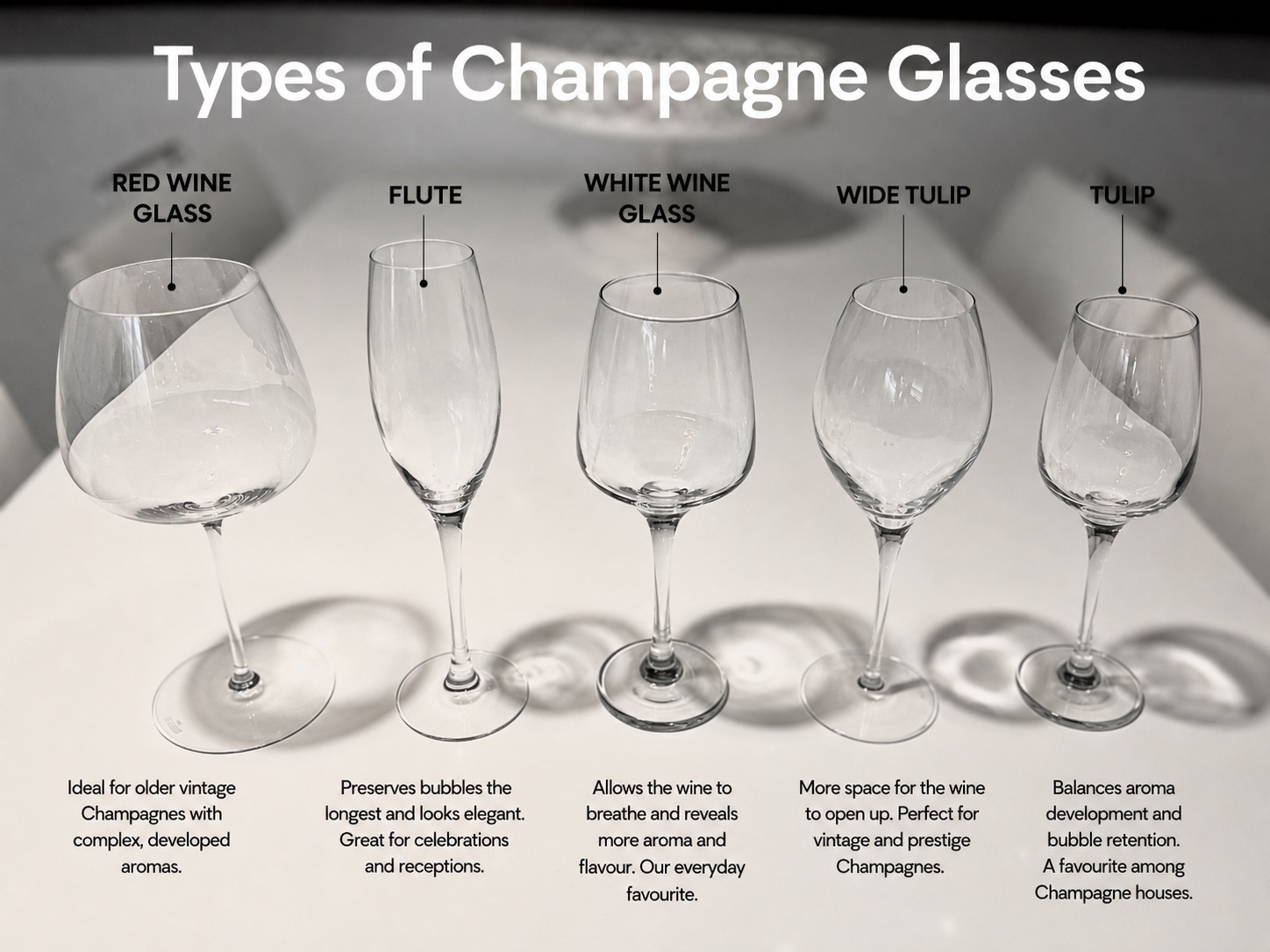
The glass you choose can completely change how a Champagne tastes.
For many years, the classic Champagne flute was considered the only proper glass for sparkling wine. Today, however, many Champagne producers, sommeliers and wine lovers have moved towards wider glasses that allow the wine to fully express its aromas and complexity.
After visiting dozens of Champagne houses and tasting hundreds of Champagnes, we’ve changed our own habits as well.
Today, you’ll almost never see us drinking Champagne from a flute.
- Why does the glass matter?
- Champagne flute
- Tulip glass
- Wide tulip glass
- White wine glass
- Don’t overlook a red wine glass
- So why don’t we use flutes
- Which Champagne glass should you choose?
Why does the glass matter?
Champagne is much more than bubbles.
A great Champagne offers aromas of citrus, white flowers, baked apple, brioche, toasted almonds, hazelnuts and sometimes even coffee or honey after many years of ageing.
A narrow glass hides many of these aromas.
The right glass allows the wine to breathe, making every sip more expressive and balanced.
Champagne flute
For decades, the Champagne flute became the symbol of celebration.
Its tall, narrow shape preserves bubbles for a long time and creates an elegant appearance. That’s one reason why flutes remain popular at weddings, receptions and large celebrations.
However, the same narrow shape also limits the development of aromas.
If your goal is simply to celebrate with a glass of Champagne, a flute works perfectly well.
If your goal is to truly understand what’s inside the bottle, there are better options.
Tulip glass
The tulip glass is considered by many Champagne professionals to be one of the best all round choices.
Its wider bowl allows aromas to develop, while the slightly narrower opening concentrates them towards your nose.
You still enjoy beautiful streams of bubbles, but you also experience much more of the wine’s character.
Many producers throughout Champagne now use tulip glasses for tastings instead of flutes.
Wide tulip glass
A wider tulip glass takes the experience one step further.
Prestige cuvées and older vintage Champagnes often benefit from additional space, allowing complex aromas to unfold gradually.
You’ll notice more layers of fruit, pastry notes, minerality and oak influence that can remain hidden in narrower glasses.
For serious Champagne tastings, this is one of our favourite choices.
White wine glass
This might surprise many people.
One of the most common glasses you’ll see in Champagne today isn’t a flute at all.
It’s a white wine glass.
Many Champagne houses now serve even their finest Champagnes in quality white wine glasses because they reveal significantly more aroma and flavour.
The wider bowl allows the wine to open naturally while still maintaining freshness.
If you’re drinking a non vintage Brut or a younger vintage Champagne, a good white wine glass is often an excellent choice.
Don’t overlook a red wine glass
One of our favourite ways to enjoy older vintage Champagne is from a big red wine glass.
Yes, a red wine glass.
Mature Champagnes evolve far beyond fresh citrus and lively bubbles. Over time they develop aromas of toasted bread, dried fruit, roasted nuts, mushrooms, coffee, honey and spice.
A quality red wine glass gives these mature wines the space they need to fully open.
It might sound unusual, but after tasting many older Champagnes, we’ve found ourselves reaching for a red wine glass surprisingly often.
So why don’t we use flutes?
Simply because we enjoy tasting Champagne as a wine rather than focusing only on the bubbles.
A flute highlights freshness and sparkle, but it limits aroma development.
For us, Champagne is about complexity, texture and character.
That’s why we almost always choose either:
- a white wine glass;
- a tulip glass;
- a wide tulip glass;
- or, for older vintage Champagnes, a quality red wine glass.
Which Champagne glass should you choose?
| Glass | Aroma | Bubbles | Our recommendation |
|---|---|---|---|
| Flute | ★★☆☆☆ | ★★★★★ | Best for celebrations |
| Tulip | ★★★★★ | ★★★★☆ | Excellent all round choice |
| Wide tulip | ★★★★★ | ★★★★☆ | Perfect for vintage Champagne |
| White wine glass | ★★★★★ | ★★★★☆ | Our everyday favourite |
| Red wine glass | ★★★★★ | ★★★☆☆ | Best for older vintage Champagne |
Our recommendation
If you’re opening a bottle just to celebrate, any Champagne glass will do.
But if you want to discover everything the winemaker intended, choose a glass that gives the wine room to breathe.
For everyday Champagne, we usually reach for a white wine glass.
For tastings, we often choose a tulip or wide tulip glass.
And when opening an older vintage Champagne, you’ll frequently find us pouring it into a quality red wine glass.
It may sound unconventional, but the results often speak for themselves.
Frequently Asked Questions
Is a Champagne flute the best glass for Champagne?
Not necessarily. While flutes preserve bubbles well, many Champagne producers and sommeliers now prefer tulip or white wine glasses because they reveal far more aroma and complexity.
Why do Champagne houses use white wine glasses?
A wider bowl allows the wine to open up, making it easier to appreciate its aromas, texture and balance.
Can you drink Champagne from a red wine glass?
Yes. Older vintage Champagnes often benefit from the extra space, allowing their mature aromas to develop beautifully.
What is the best Champagne glass?
There isn’t one perfect answer. For younger Champagnes, we recommend a quality white wine or tulip glass. For mature vintage Champagnes, a smaller red wine glass can be an outstanding choice.
Final thoughts
Choosing the right glass won’t change the Champagne in the bottle, but it can completely change your experience of it.
While the classic flute remains part of Champagne’s history, today’s tasting culture has evolved. More producers, sommeliers and enthusiasts are choosing glasses that allow the wine to reveal its full personality rather than simply showcasing its bubbles.
Our advice is simple. Experiment with different glasses. Pour the same Champagne into a flute, a tulip and a white wine glass, then compare them side by side. You may be surprised by just how different the same bottle can taste.